
PACM Guidelines
Criteria
The PACM series adheres to the following principles:
- Clear documentation of review process and policy
- Minimum of two expert reviewers with written reviews
- Reviewers may be drawn from outside the conference Program Committee
- Minimum of two-cycle review with opportunity for major revisions reviewed by same reviewers
- Specific provisions for conflict-of-interest
Attendance at the affiliated events cannot be mandatory.
Basic Assumptions
- There will be no professional copy editing. ACM has partnered with International Science Editing (ISE) to provide language editing services to ACM authors. (Editing services are at author's expense and do not guarantee publication of a manuscript.)
- There will be no professional typesetting. Authors must use the template selected by the title, either the ACM large or the ACM small option within the Consolidated ACM TeX or Word template available at https://www.acm.org/publications/authors/submissions.
- Production costs charged to the SIGs for these journals will be in line with previous article production costs.
1. Submission Systems
PACM editors may choose whichever submission system they are most comfortable with. At a minimum, the chosen submission system needs to support at least two rounds of review and revision and maintain reviewer assignments through to decision.
ACM recommends use of one of the following submission systems because they are integrated with ACM eRights and production systems to minimize the need for duplicate metadata capture and thus enable efficiency in flow to final production and publication:
- HotCRP
- EasyChair
- PCS
If you are planning to use a different system, please send your point of contact at the submission system to Yubing Zhai, ACM Journal Editor, so ACM HQ can arrange integration with our eRights Management System (if possible).
2. eRights System
The designated Editor or appointed production vendor of a specific issue is responsible for submitting an XML file including all necessary rights metadata of the accepted papers. A sample file with the details and delimiters of what must be supplied can be provided.
3. ISSN
ACM will file for ISSNs for each PACM title, register them with the Library of Congress, and distribute them as soon as they are acquired. The PACM proposal needs to include the expected periodicity for the title (even if it may change in the future).
4. Journal Website
Each PACM title will have its own Journal website in the Digital Library. ACM HQ staff will work with the Editor(s)-in-Chief of each PACM journal and/or its Information Director to set up and maintain the journal site. For an example of the standard ACM Journal website, see: https://imwut.acm.org/.
It is important that PACM journal home pages, Calls for Papers, and Editorials in the published issues refer to the PACM editorial process and avoid the old terminology of conferences such as program committees, conference chairs, and the like.
* Note that issues can be named with character strings rather than enumerated. Thus, naming convention can be Vol. 1/Iss. OOPSLA or Vol. 1/Iss. POPL, etc.
5. Editorial Structure
It is important that each PACM title have a recognizable journal editorial structure rather than a Program Committee listing. The following is the recommended structure:
- Editor-in-Chief (3-year term, renewable once)
- Editor/Track Editor (1-year term; equivalent to program committee chair of conference in specified year)
- Associate Editor (1-year term; equivalent to program committee associate chairs/area chairs in specified year)
- Review Committee/Review Board (1-year term; equivalent to program committee members or similar in specified year)
- Artifact Review Committee (1-year term, if applicable)
There may be an Advisory Board consisting of the sponsoring SIG's or SIGs' leadership and/or past editors and associate editors, tasked with providing long-term guidance to the Title. Please refer to the defined journal editorial roles at: http://www.acm.org/publications/policies/position-descriptions
The Editor-in-Chief role of an ACM journal has several distinguishing features:
- Ultimate responsibility for the journal’s contents,
- Authority to appoint and dismiss members of the Editorial Board at will,
- A service term of three years, renewable once, and
- Appointment by the ACM Publications Board.
It is expected that the sponsoring SIG(s) for each title will form a Search Committee for the editor-in-chief position of the title. Their nominee for Editor-in-Chief should be recommended to the Chair of PACM Steering Committee Philip Wadler with a CV, vision statement, and short report of the search process. The Publications Board has the final approval and will issue the official Letter of Appointment to the Editor-in-Chief of each journal.
6. Promotion
ACM will promote each PACM title individually. Bruce Shriver will work with you and Yubing Zhai to produce promotional material and determine the best venues for exposure to attract authors and readers.
7. Supplemental Material
ACM will provide a secure submission site for authors to upload their supplemental materials. The supplemental material will be published in the Digital Library with its corresponding main article.
8. TMRFs
The same application process will take place for your events. However, you will need to indicate whether there will be a journal publication and/or a proceedings publication. The TMRF forms have been modified to accommodate the existence of a PACM title in addition to, or instead of, a Proceedings.
9. Vendors
The Editor-in-Chief or the Editor of an issue is responsible for selecting the set of articles for each issue and indicating a particular sequence if desired. In addition, articles may be grouped in sections and if so, Section Title must be supplied. Editors may choose to work with vendors of their choice for final production of issues. However, ACM must approve these vendors and have specific contacts to work with to ensure that PACM specifications are met. If you have a selected vendor, the complete DL-ready manuscript package should be submitted to ACM at least three weeks** prior to the scheduled publication date for the issue.
**NB: This production schedule depends on authors using the ACM PACM template without manipulating page layout specifications. Otherwise, production of their articles could be delayed until the next issue or another two weeks should be built into your delivery schedule.
10. Covers, Mastheads, and Tables of Contents
ACM will supply the cover image for each issue published in the DL along with the inside covers including masthead and journal information. The ACM vendor (or the vendors you choose) will be responsible for generating the Tables of Contents from the issue line-ups provided by the Editor. See the Production Instructions for detailed production information.
11. Digital Library Displays
Previous proceedings series that have transitioned to PACM journals may have a listing in the DL for the event that will point to the journal issue or issues whose articles are presented at the event.
PACM Governance
The PACM Steering Committee is charged with PACM oversight and operation. However, each PACM journal will have an Editorial Board structured according to its own proposed and approved governance system. The ACM Publications Board has ultimate authority over the PACM Series and each of its titles.
Proceedings of the ACM Series
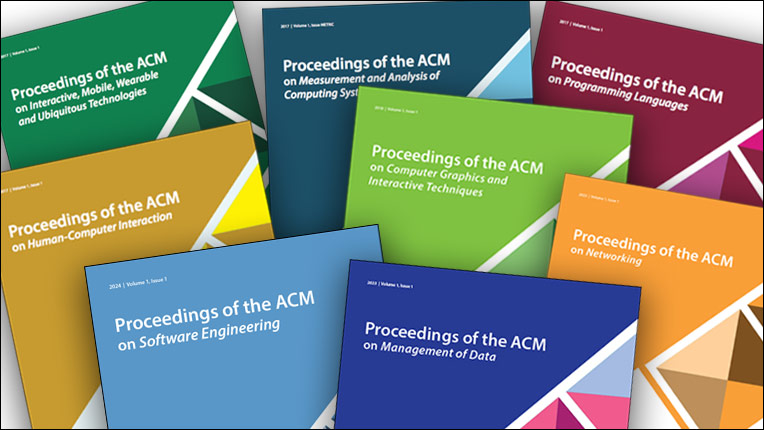
Proceedings of the ACM (PACM) is a journal series that launched in 2017. The series was created in recognition of the fact that conference-centric publishing disadvantages the CS community with respect to other scientific disciplines when competing with researchers from other disciplines for top science awards and career progression, and the fact that top ACM conferences have demonstrated high quality and high impact on the field. See PACMs on Programming Languages, Interactive, Mobile, Wearable and Ubiquitous Technologies, Measurement and Analysis of Computing Systems, and HCI.
How to Apply
If your conference has an established record of high quality, judged by standing in the field, citations, and other measures used by the PACM Steering Committee, you may consider applying for inclusion in the PACM journal series. The application guidelines serve as a template for what to include in a PACM proposal. The Steering Committee will review the proposal, work with the proposers on potential revisions, and then decide whether to forward a proposal to the ACM Publications Board for final approval.
Production Instructions
Once a proposal has been approved, your production team will need to be assembled. Detailed instructions for PACM production vendors are found in the PACM production guidelines and required metadata documents. ACM templates must be used by authors to ensure a uniform look to the journals program.
New Authoring Templates for ACM Publications
ACM has transitioned to new authoring templates. The new template consolidates all eight individual ACM journal and proceedings templates. The templates are updated to the latest software versions, have been developed to enable accessibility features, and use a new font set.

PACM on Human-Computer Interaction
Proceedings of the ACM on Human-Computer Interaction (PACM HCI) is a journal for research relevant to multiple aspects of the intersection between human factors and computing systems. PACMHCI covers a broad range of topics and methods that help illuminate the intersection between humans and computing systems. The scope of this journal includes research contributions in new systems for input and output, studies of user experiences with computing systems, scholarship on the individual and group effects of computer mediation, and societal impacts of new human computer interactions.
PACM Series on Measurement and Analysis of Computing Systems
The PACM Series on Measurement and Analysis of Computing Systems (POMACS) publishes original research of the highest quality dealing with performance of computing systems, broadly construed. We recognize that critical insights into key design trade-offs in computer or network systems have historically be obtained using a broad set of tools: benchmarking and experimental evaluation, mathematical modeling, algorithmic analysis, which often need to be combined creatively.