

Education
ACM’s educational activities, conducted primarily through our Education Board and Advisory Committee, range from the K-12 space (CSTA) and two-year programs to undergraduate, graduate, and doctoral-level education, and professional development for computing practitioners at every stage of their career...
Curricula Recommendations
2023 Computer Science Curriculum Guidelines Revision
ACM has joined with the IEEE Computer Society and the Association for the Advancement of Artificial Intelligence to develop "Computer Science Curricula 2023” (CS2023). CS2023 provides a comprehensive guide outlining the knowledge and competencies students should attain for degrees in computer science and related disciplines at the undergraduate level. Establishing uniform curricular guidelines for computer science disciplines is essential to the ongoing vitality of the field and the future success of those who study it.
First-Ever Computing Competencies for Undergraduate Data Science Curricula
A new report from the ACM Data Science Task Force, convened by ACM’s Education Board, seeks to define what the computing/computational contributions are to this new field, as well as to provide guidance on computing-specific competencies in data science for departments offering such programs of study at the undergraduate level. The document, “Computing Competencies for Undergraduate Data Science Curricula,” also invites collaborations with statisticians, mathematicians, and others in this interdisciplinary field.
ACM and IEEE-CS Release Computing Curricula 2020, Global Guidelines for Baccalaureate Degrees in Computing
ACM and IEEE Computer Society have issued "Computing Curricula 2020 (CC2020): Paradigms for Global Computing Education." Developed by a 50-member task force drawn from 20 countries, CC2020 outlines global recommendations for baccalaureate degrees in computing. Designed to be comprehensive, CC2020 delineates the latest curricula for computer engineering, computer science, information systems, information technology, and software engineering, as well building on the CC2005 document with newer disciplines such as cybersecurity and data science.

Ethical and Societal Impacts of GenAI in Comp Ed: ITiCSE 2025 WG Report
View the panel webinar "Ethical and Societal Impacts of GenAI in Comp Ed: ITiCSE 2025 WG Report," presented by the ACM Ethical and Societal Impacts of GenAI taskforce.
The working group on the Ethical and Societal Impacts of Generative AI in Higher Computing Education was convened at the ITiCSE 2025 conference and produced a report titled "Navigating the Ethical and Societal Impacts of Generative AI in Higher Computing Education." In this webinar, you will hear from the lead authors of that report.
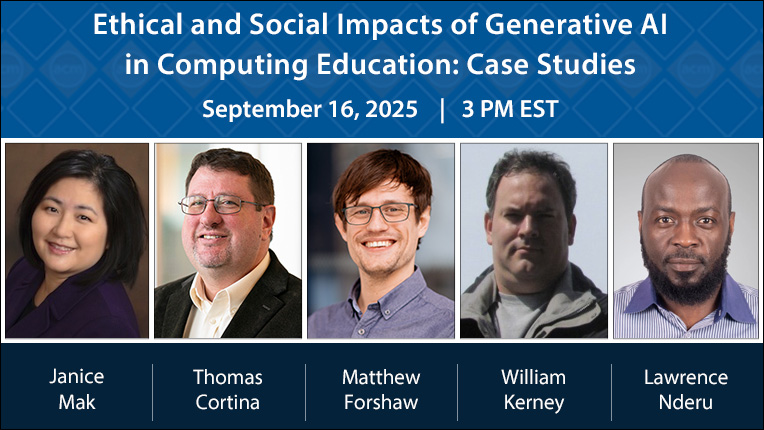
Ethical and Social Impacts of GenAI in Computing Education: Case Studies
View the panel webinar "Ethical and Social Impacts of GenAI in Computing Education: Case Studies," presented by the ACM Education Board Task Force on the Ethical and Social Impacts of Generative AI in Higher Education.
The panel was comprised of Matthew Forshaw (The Alan Turing Institute); Bill Kerney (Clovis Community College), and Lawrence Nderu, Jomo Kenyatta University of Agriculture and Technology (JKUAT). Tom Cortina (Carnegie Mellon University) and Janice Mak (Arizona State University) moderated the talk.
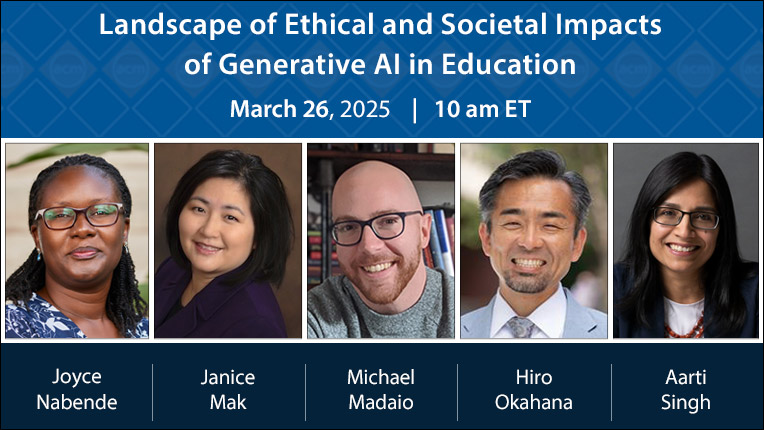
Landscape of Ethical and Societal Impacts of Generative AI in Education
View the panel webinar "Landscape of Ethical and Societal Impacts of Generative AI in Education," presented by the ACM Education Board Task Force on the Ethical and Social Impacts of Generative AI in Higher Education.
The panel was comprised of Michael Madaio,(Google Research), Hironao Okahana (Education Futures Lab), and Aarti Singh (Carnegie Mellon University). The talk was moderated by Janice Mak (Arizona State University) and Joyce Nakatumba-Nabende (Makerere University).
Watch 2026 ACM SIGSE TS Keynote and Other Notable Sessions
The ACM Special Interest Group on Computer Science Education (SIGCSE) has made key sessions from the 2026 SIGCSE Technical Symposium available in its YouTube Channel.
Highlights include the closing keynote by Titus Winters, Senior Principal Scientist at Adobe, "CS and SE Education, Post-AI." In the keynote, Winters provides some industry perspective, identifies what seems outdated in CS and SE pedagogy, and tries to sketch out some more fruitful directions for revision to our assignments, classes, and overall curricula.
Language Matters: DEI and the Question of URM
View the webinar, “Language Matters: DEI and the Question of URM,” featuring Nicki Washington of Duke University and Tiffani L. Williams of the University of Illinois at Urbana-Champaign in discussion on the importance of language to promote inclusive environments for work and study. The webinar was organized by the ACM Education Board’s Diversity, Equity, and Inclusion in Computing Education Task Force and ACM’s Diversity, Equity, and Inclusion Council, and was moderated by DEI-CE co-chair Fay Cobb Payton.
Confronting Ethical Challenges in a High-Tech World
Machine Learning has tremendous potential for developing tools to improve efficiency and accuracy in decision-making. However, ML also has the potential to lead to outcomes that reinforce human biases, disproportionately impact vulnerable populations, and violate notions of privacy. Mehran Sahami and moderators Fay Cobb Payton and Susan Reiser as they explore some of the promise and perils that arise from Machine Learning to understand both some of the ethical issues and competing value trade-offs at stake.
ACM Education Board and Advisory Committee
ACM education activity has been reorganized into two entities: the Education Board and the Education Advisory Committee (EAC). The Board wields the final executive and decision-making power to facilitate the work of the Advisory Committee. The Advisory Committee is a task-force-based, networking-oriented environment whose aim is to promote ACM's educational mission to as wide a range of constituencies as possible: universities, community colleges, high schools, corporations, and the U.S. government.
Briana B. Morrison Named Co-Chair of ACM Education Board
Briana B. Morrison joins Alison Derbenwick Miller as Co-Chair of ACM's Education Board and Advisory Committee, to serve for the two-year term ending June 30, 2026. Morrison is Associate Professor in Computer Science at the University of Virginia. She has served on the ACM SIGCSE Board, the ACM Education Committee, past co-editor of EngageCSEdu, and past Higher Ed Co-Chair of the AP CS A Development Committee. Derbenwick Miller is an independent consultant and Strategy Advisor to the Stanford Deep Data Research Lab.

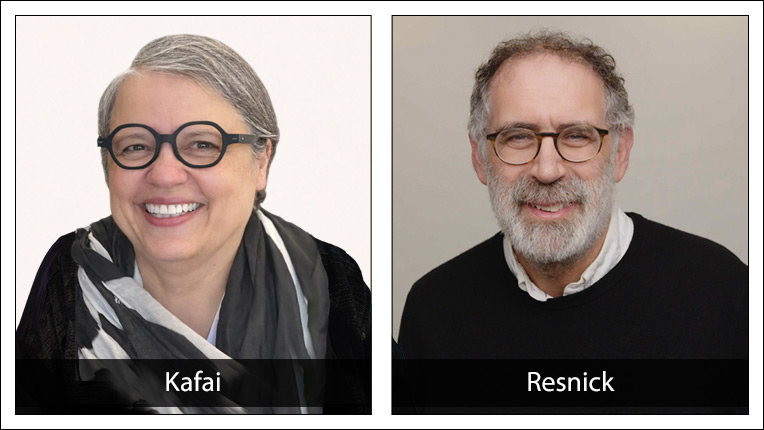
Karlstrom Educator Award Goes to Yasmin B. Kafai and Mitchel J. Resnick
Yasmin B. Kafai, Professor of Learning Sciences at the University of Pennsylvania, and Mitchel J. Resnick, Professor of Learning Research at the Massachusetts Institute of Technology, receive the Karl V. Karlstrom Outstanding Educator Award for long-lasting and collective contributions to creative computing, including Scratch and electronic textiles, developing new ways for young people to create and collaborate within learning communities. Scratch has become the world’s largest coding community for young people, with more than 150 million registered users who have created over 1 billion projects.
ACM Skills Bundle Add-On
ACM has created a new Skills Bundle add-on providing unlimited access to ACM's collection of thousands of online books, courses, and training videos from O'Reilly and Skillsoft Percipio. ACM’s collection includes more than 60,000 online books and video courses from O’Reilly; and 10,000 online courses (including Codecademy), 13,000 eBooks and audiobooks, and 1,400 interactive labs from Skillsoft.
The new Skills Bundle add-on is available to paid Professional Members only. Visit the ACM subscription page or contact Member Services to add the Skills Bundle to your membership.
Computing Enrollment and Retention: 2019-20 through 2023-24
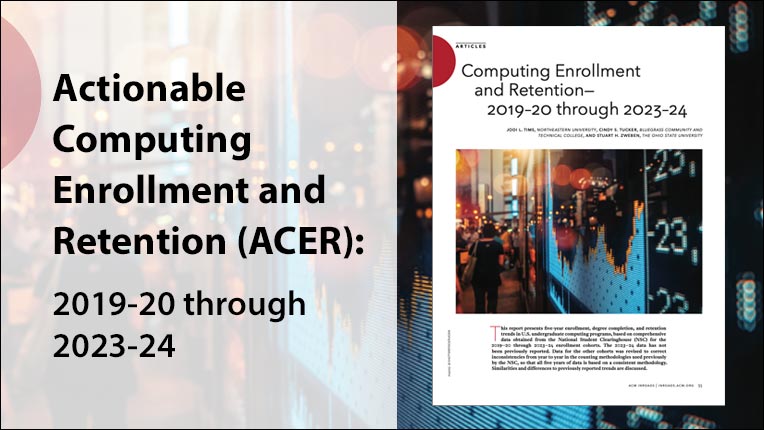
For the past several years, the Actionable Computing Enrollment and Retention (ACER) project of the ACM Education Board has analyzed and reported about enrollments, degree completions, and retention in undergraduate computing programs in the US. This report is based on comprehensive data obtained from the National Student Clearinghouse (NSC) for the 2019–20 through 2023–24 enrollment cohorts. The 2023–24 data has not been previously reported. Data for the other cohorts was revised to correct inconsistencies from year to year in the counting methodologies used previously by the NSC.
Education Board Retention Committee Report on CS Undergraduate Student Retention
The ACM Education Board's Retention Committee has released "Retention in Computer Science Undergraduate Programs in the U.S.: Data Challenges and Promising Interventions." The report calls for additional research to provide a more nuanced understanding of the dynamics of attrition and retention, and encourages higher education institutions to provide proactive counseling to undergraduate students about career opportunities in CS.
European Informatics Retention and Graduation Rate Report
European higher education is as diverse as the continent’s cultures and traditions. This also means that making analyses and meaningful comparisons can be complex. The area of Informatics is no exception. This report presents the first pan-European analysis of student retention and graduation rates in bachelor-level Informatics programmes. Conducted jointly by Informatics Europe and ACM Europe, it draws on the Informatics Europe Higher Education (IEHE) Data Portal and examines trends across thirteen European countries over the period 2010 to 2023.

Report Aims to Smooth Transition between Community College and Computing Career
A report by the ACM Education Policy Committee analyzes various initiatives being implemented throughout the US that aim to increase the pipeline of students pursuing computing degrees; identify programs that have had the most success; and describe aspects of these programs that could be emulated elsewhere.
GenAI and Student Programming Assessment Report and Community Approaches
The ACM Task Force on Generative Artificial Intelligence and Student Programming Assessment was formed to track the evolution of approaches to teaching programming in the era of GenAI, document concrete examples of integration strategies, and assemble emerging best practices to support instructors in adapting their courses and assessments. Visit the Task Force website to view its recent report (based on a survey of more than 700 educators), explore community approaches to integrating GenAI into computing education, as well as to contribute an approach.
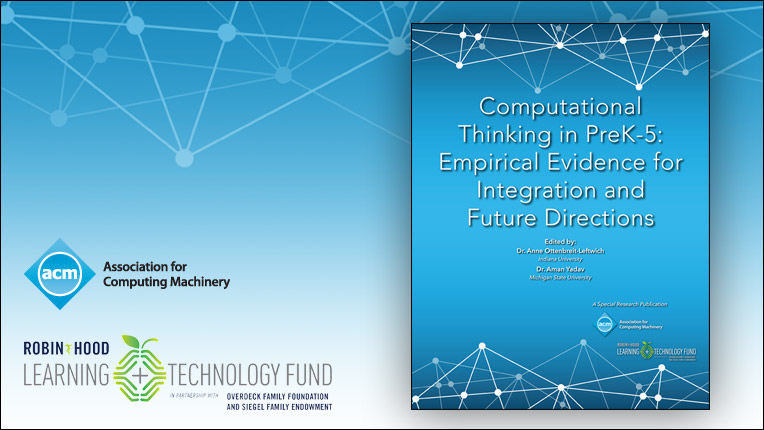
Research Publication on Integrating Computational Thinking at the PreK-5 Level
Although research on computational thinking (CT) within K-12 has been emerging over the past few years, few studies have investigated the teaching of CT at the younger ages. The ACM and the Robin Hood Learning + Technology Fund co-funded this special research publication to examine empirically-based studies that focused on the integration of computational thinking at the elementary levels into a variety of learning disciplines including math, ELA, science, and computer science.
Contribute Instructional Materials to EngageCSEdu
Did you know that the ACM Education Board has a special project that allows you to share outstanding instructional materials from your classes? EngageCSEdu publishes high-quality, engaging, classroom-tested Open Educational Resources (OER’s) for computer science education. OER’s accepted for publication must use at least one research-based engagement mechanism aimed at increasing diversity and inclusion, e.g., culturally responsive pedagogy or an engagement practice from the NCWIT engagement framework. General submission information can be found on the content submission site.

2023 Computer Science Curriculum Guidelines Revision
ACM has joined with the IEEE Computer Society and the Association for the Advancement of Artificial Intelligence to develop "Computer Science Curricula 2023” (CS2023). CS2023 provides a comprehensive guide outlining the knowledge and competencies students should attain for degrees in computer science and related disciplines at the undergraduate level. Establishing uniform curricular guidelines for computer science disciplines is essential to the ongoing vitality of the field and the future success of those who study it.
First-Ever Computing Competencies for Undergraduate Data Science Curricula
A new report from the ACM Data Science Task Force, convened by ACM’s Education Board, seeks to define what the computing/computational contributions are to this new field, as well as to provide guidance on computing-specific competencies in data science for departments offering such programs of study at the undergraduate level. The document, “Computing Competencies for Undergraduate Data Science Curricula,” also invites collaborations with statisticians, mathematicians, and others in this interdisciplinary field.
ACM and IEEE-CS Release Computing Curricula 2020, Global Guidelines for Baccalaureate Degrees in Computing
ACM and IEEE Computer Society have issued "Computing Curricula 2020 (CC2020): Paradigms for Global Computing Education." Developed by a 50-member task force drawn from 20 countries, CC2020 outlines global recommendations for baccalaureate degrees in computing. Designed to be comprehensive, CC2020 delineates the latest curricula for computer engineering, computer science, information systems, information technology, and software engineering, as well building on the CC2005 document with newer disciplines such as cybersecurity and data science.
ACM Europe and IE Release Informatics Education Strategy
The ACM Europe Council and Informatics Europe have collaborated on a report that builds on an earlier document, "Informatics Education in Europe: Are We All in the Same Boat?". The report, "Informatics for All: The Strategy," aims to establish Informatics as an essential discipline for all, a subject available at all levels throughout the educational system. The strategy is also summarized in a one-page document.

CRA Surveys Computer Science Faculty, Department Heads on COVID-19's Impacts
The Computing Research Association (CRA) conducted two surveys about the COVID-19 disruption in summer 2020. One surveyed computer science faculty members about their experiences transitioning from teaching in person to teaching online as the result of the COVID-19 pandemic. The other surveyed department chairs, asking them about the impact of COVID-19 on their faculty, department operations, student job searches, and budgets, and their concerns going into fall 2020.
Informatics for All Welcomes European Council Recommendations
The Council of the European Union has adopted a set of recommendations on digital skills and education. The Informatics for All Coalition has endorsed the bold recommendations outlined in the new Council report. The recommendations of the Council reflect a timely and ambitious approach towards the development of digital competences, addressing the need to make education fit for a genuine digital transformation and able to keep pace with the times, while providing the necessary skills and competences that are necessary in this new reality.


Lifelong Learning
ACM offers lifelong learning resources including online books and courses from Skillsoft, TechTalks on the hottest topics in computing and IT, and more.