


Alison Derbenwick Miller Named CEO of ACM
ACM has named Alison Derbenwick Miller Chief Executive Officer and Executive Director effective August 3, 2026. As ACM’s most senior staff member, she will work alongside ACM's volunteer leadership and professional staff to strengthen the Association's role as the global home for the computing community while advancing its mission of research, education, professional development, and scientific collaboration. A longtime ACM volunteer leader, Derbenwick Miller brings more than three decades of executive leadership experience spanning research, education, enterprise technology, and global partnerships.
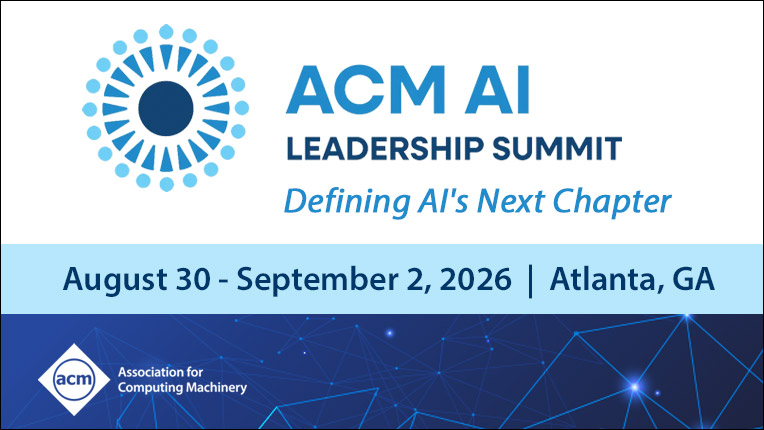
Defining AI's Next Chapter
Artificial intelligence is advancing rapidly, but some of the most important questions about its future extend far beyond technology alone. How should AI be governed? How will it transform scientific discovery, education, creative work, and the workforce? To explore these questions, ACM is bringing together an exceptional group of leaders from research, industry, government, and education at the inaugural ACM AI Leadership Summit. Speakers include ACM Turing Award laureates Yann LeCun and Andrew Barto, United Nations Secretary-General's Envoy on Technology Amandeep Singh Gill, ACM Prize in Computing recipient Amanda Randles, and many others. The event will be held in Atlanta, Georgia, Aug. 30 – Sept. 2.
Learn more about the event and its goals in this recent Communications of the ACM article from the organizers of the ACM AI Leadership Summit.




A Look in the Mirror: ACM Demographics
The long-awaited first-ever ACM Demographic Report is here! Published in Communications of the ACM, the ACM Diversity, Equity, and Inclusion Council surveyed more than 110,000 ACM members, conference attendees, and authors to better understand the demographics of those participating in ACM activities. As a global scientific and educational organization, ACM uses the demographic report to answer two important questions: who are ACM’s members, and who does ACM represent?
Read and discover the demographic breakdown of the survey in the July CACM Issue.

Is Now the Time to Give LLMs Access to the ACM Digital Library? Share Your Feedback
Read a message from ACM President Elisa Bertino about the possibility of opening the ACM Digital Library to LLMs. While ACM's Publications Board and Digital Library Board have discussed allowing LLMs to train on articles in the Digital Library, ACM has not made a decision regarding whether or how the Digital Library might be used for LLM training. Your input is an important part of ensuring ACM continues to serve the computing community thoughtfully and responsibly. If you have not yet shared your perspectives, please read President Bertino's message and consider participating in the survey.

ACM SIGGRAPH Election
The 2026 ACM SIGGRAPH Elections are now closed.
Results will be posted shortly.

2026 ACM General Election Results
For the term 1 July 2026 — 30 June 2028
President: Elisa Bertino
Vice President: Rashmi Mohan
Secretary/Treasurer: Tom Crick
For the term 1 July 2026 — 30 June 2030
Members-at-Large: Lydia Tapia and Holly Yanco

A Message to the Computing Community About ACM's Transition to Full Open Access
ACM is pleased to share an important milestone for the computing field. As of January 2026, all ACM publications and related artifacts in the ACM Digital Library have been made open access. This change reflects the long-standing and growing call across the global computing community for research to be more accessible, more discoverable, and more reusable. This transition is the result of extensive dialogue with authors, SIG leaders, editorial boards, libraries, and research institutions worldwide. ACM is grateful for the community’s consistent advocacy for openness and its commitment to ensuring that computing knowledge is shared widely.
Illuminating Secrets: Power LED-Based Side-Channel Attacks for Key Extraction and Eavesdropping
The accurate indication of a device’s power consumption through optical measurements obtained from its power LED raises concerns regarding information confidentiality. In the August issue of Communications of the ACM, Ben Nassi explores how attackers can exploit this undesired correlation to launch cryptanalytic attacks on the device and to launch speech eavesdropping attacks on the device’s users. He illustrates how attackers can recover audible speech played by speakers by analyzing the optical traces obtained by a photodiode from the power LED of the speakers, and assesses various methods to enhance the confidentiality of information processed by devices against these attacks.
CACM Special Section: Federal Funding of Academic Research
Technological innovation is not just a byproduct of American ingenuity—it is its driving force. Most of the United States' 20th-century productivity growth stemmed from domestic breakthroughs in science and technology. And it is federal funding of basic research which has sparked and sustained the modern technological revolution. Yet despite the extraordinary returns of this investment, federal support for basic research is being sharply curtailed. This special section of Communications of the ACM raises the critical question: Can America remain a global innovation powerhouse if it sidelines the very engine that powered past progress?
ACM Queue Spotlight
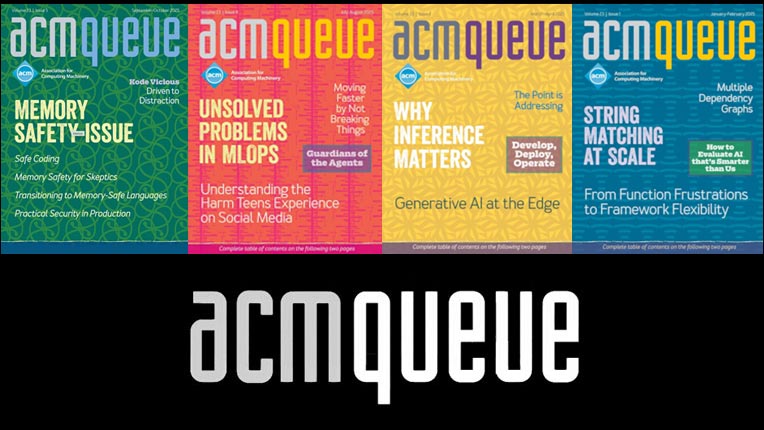
In the latest edition of ACM's magazine for practicing software engineers: Memory safety—the property that makes software devoid of weaknesses such as buffer overflows, double-frees, and similar issues—has been a popular topic in software communities over the past decade and has gained special prominence alongside the rise of the Rust programming language. But if you're not yet sold on its value, "Memory Safety for Skeptics" by Andrew Lilley Brinker is for you. The goal of the article is to treat the question of pursuing memory safety in legacy systems with the seriousness and rigor that it deserves—and as worthwhile with or without Rust.
Statement on Academic Freedom and Scientific Collaboration
ACM reaffirms the importance of openness, international collaboration, and the free exchange of ideas in advancing computing research and education. The open exchange of ideas and freedom of thought and expression are central to ACM’s mission. ACM believes that scientific progress depends on freedom of inquiry, communication, global mobility, and international collaboration for researchers worldwide. ACM remains committed to fostering an inclusive global research community in which individuals are able to pursue, discuss, and disseminate scientifically grounded work on important computing and societal challenges for the public good.
Become an Ambassador for ACM
Encourage your colleagues to join ACM, share the benefits of ACM and receive free gifts for participating. Your support of ACM is critical to our continuing efforts to advance computing as a science and a profession.

ACM Code of Ethics
The ACM Code of Ethics and Professional Conduct was updated in 2018 to address the significant advances in computing technology since the 1992 version, as well as the growing pervasiveness of computing in all aspects of society.
Lifelong Learning
ACM offers lifelong learning resources including online books and courses from Skillsoft, TechTalks on the hottest topics in computing and IT, and more.


Send Email as Your "@acm.org" Address
ACM is excited to announce a new enhancement of to the widely used ACM email forwarding service. Through a partnership with MailRoute, SMTP Auth Relay is now available for member use. To start sending fully authenticated email as your @acm.org address, simply log in at https://myacm.acm.org and click the "SMTP Auth Relay" link.