
Celebrate Black Pioneers with ACM
Imagine being one of the first in your field or becoming a pioneering force who helped open the door for inclusion. For Black History Month 2026, ACM is excited to share a video series highlighting the stories of past and present Black pioneers in computing. Their groundbreaking work has shaped the computing field while expanding access to computer science for people with diverse backgrounds. Join us through the month of February to celebrate their legacies and achievements. Follow this video series on X, Instagram, Facebook, Matsodon, Threads, Bluesky and Linkedin.
POV: You are constantly rejected due to your skin color despite your qualifications. Determined to succeed, you refuse to give up. You adapt to the latest technology to build a future on your own terms.
Roy Clay became a pioneering computer scientist, laying the groundworks for what would later be known as Silicon Valley. In 1962, Clay joined Hewlett-Packard where he launched and led the Computer Science division. He wrote software for HP’s first minicomputer, the HP 2116A.
Clay would move on to found Rod-L Electronics in 1977 which manufactures electrical safety test equipment. Known as the “Godfather of Silicon Valley,” Clay created programs to help African-American get into Silicon Valley, ensuring others have access to the industry.
POV: You’ve just relocated to Cleveland, Ohio and you’re desperate for a job. You come across an article from an agency you’ve never heard of before, NASA.
Annie Easley’s career as a “human computer” spans 34 years. She adapted her talents to learn FORTRAN and SOAP which became essential to the development of NASA’s Centaur rocket and later contributed to the 1997 launch of Cassini.
Later in her career, Easley would become an Equal Employment Opportunity counselor. She worked to support women’s rights and challenge workplace inequality at NASA, paving the way for future generations in STEM.
POV: It’s 1952, and you’re recruited as an applied mathematician at the National Bureau of Standards. When that role ends, your experiences introduces you to a new field called computer programming and leads you to IBM.
Evelyn Boyd Granville became the second African-American woman to earn a PhD in Mathematics. After starting her career in academia, she became a computer programmer when working at IBM. Through IBM’s contract with NASA, she worked on programs that tracked orbits for the Vanguard satellite and Mercury spacecraft.
After leaving IBM, Granville continued working in aerospace, contributing to celestial mechanics and trajectory calculations for the Apollo program. She would later return to academia as a professor of mathematics.
POV: You’re interested in technology, but your school only had one computing class. In college, you rediscovered your love for coding and learned Python.
Marlene Mhangami is a Zimbabwean developer advocate/software engineer. She’s dedicated to building accessible computing communities across Africa. She organized the first PyCon Africa in 2019 and founded ZimboPy, a nonprofit that empowers Zimbabwean women to learn coding.
In 2017, Mhangami became the first African woman to join the Python Software Foundation board. She currently serves as the Chair of ACM Practitioner Board, helping develop programs to support the professional needs of ACM members.
Episode 1 - Audrey Mbogho: Building Community and Belonging in Technical Spaces
In the first episode of Voices of ACM-W, we speak with Audrey Mbogho — machine learning researcher, educator, and long-standing ACM-W volunteer — about community, leadership, and the care required to sustain inclusive spaces in technology.
Drawing on her leadership within ACM-W initiatives and her academic work across Africa, Audrey reflects on resilience, shared leadership, and the invisible labour that keeps volunteer-driven communities alive.
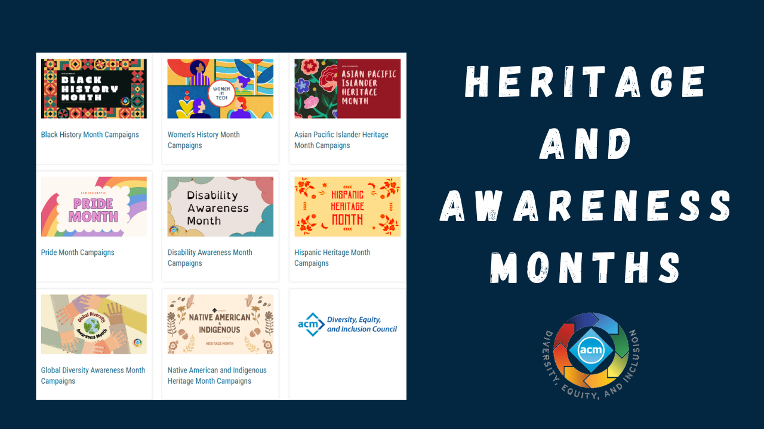
Awareness Months Archive
Embracing diverse perspectives, backgrounds, and experiences enrich the ACM community and strengthen ACM's ability to support the global computing community. Awareness months are a time dedicated to reflection, education, and engagement to understand and embrace the diverse membership within the ACM community. Our archive display the past and current celebrations ACM have created to foster an inclusive and equitable environment for all within the computing community.
How Diverse Is Your Team?
ACM's Diversity, Equity, and Inclusion Council is an essential resource for SIGs, conferences, boards, and councils looking for best practices to improve diversity in their organization and develop programs with a broader reach in the computing community. Our guide provides examples of both inherent and acquired characteristics, which should be taken into consideration when looking at ways to improve the diversity of your team.

Words Matter
As part of ACM’s efforts to combat exclusion in the computing profession, ACM's Diversity, Equity, and Inclusion Council has launched an effort to replace offensive or exclusionary terminology in the computing field. They have developed a list of computing terms to be avoided in professional writing and presentations and offer alternative language. The Council plans to expand this list in the future and invites the community to submit suggestions for consideration.