

People of ACM European Chapters - Zachary Hutchinson
March 17, 2026
You’ve said modern AI has drifted away from its roots. Will you discuss this problem and how you would like to see things change?
AI chases those hard problems that seem within computational reach because biology solves them. When we make progress in one area a lot of money starts to fall from the sky and the field narrows significantly around those piles of coin. I would like to see more support for avant garde, interdisciplinary AI work. Show me a room with a high school student, a neuroscientist, a Lutheran minister, and a network engineer working on an AI idea and I’ll be the first to join. I would like a broader definition of intelligence for AI than the mathematical, problem-solving one we’ve inherited. In fact, we will need many definitions. And, instead of putting the latest AI tool into the current version of everything, I would like a full CS-approach to AI that believes that AI will require radical new OSes, hardware, networks, peripherals, languages…and not just a million GPUs and an input prompt.
A project you presented this year at ACM SIGCSE, “Maine AI Arena” (MAIA) presents a new system for developing AI competitions. Why are competitions effective tools for teaching AI? What makes the Maine AI Arena different?
Competitions are places where we can test our work, learn from each other and enjoy the wreckage of ideas. They can motivate those new to the field. For me, they are not about winning or losing or accuracy—they are arenas to study AI-AI interaction, a field I believe will be crucial for more advanced forms of AI. MAIA’s goal is to help anyone set up introductory, local AI competitions for their students. Its requirements and setup are minimal. Being completely local, it allows educators to tailor the scenarios to their students. The project is still under development.
What recent advances in neuroscience may shape AI in the coming years?
Both fields are in desperate need of tools and language to interpret the communication between meso-sized objects or networks. A breakthrough in one might speak to both. This would help us connect what is directly measurable to what is only observable in the wild woods of interaction. But I’m not sure AI needs immediate neuroscience advances as much as it needs to fully adopt to neuroscience’s rules of the game. Biological intelligence shines out of a system of heterogenous neurons and brain regions talking to an ever-changing body surviving in a world of similar strangers.
What was the impetus for starting the ACM-W Student Chapter at the American University in Bulgaria? What are some of your regular (or planned) activities?
The impetus belongs to the students. I turn the answer over to our chapter chair, Anna Kukova, who stated:
“The long-term vision for ACM-W is to get more people interested in undergrad research, helping them decide if they want to go to grad school and continue down the research path or not. Finally, just having a tight-knit network of women in computer science on campus has been great.”
AUBG is a four-year liberal arts college; therefore, we lack the typical research opportunities available to many undergraduates. Our chapter is stepping into this void by organizing research talks and participating in a fledgling research group with the goal of presenting several posters at the 2026 ACM womENcourage conference. Our next event will focus on making connections with AUBG alumni and industry so it can put down roots in the wider community.
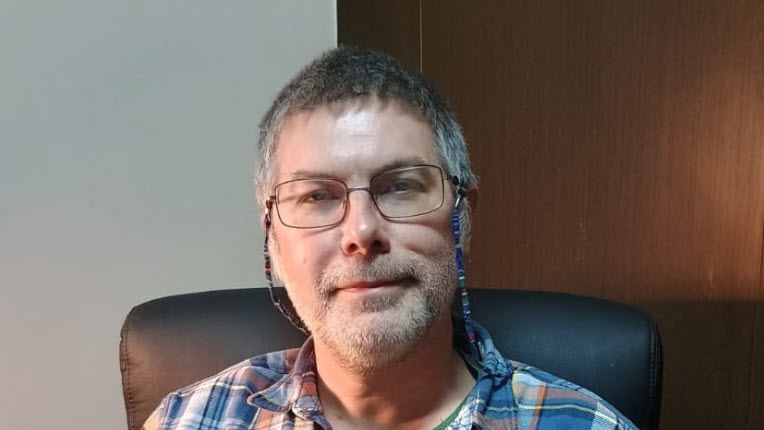
Zachary Hutchinson is an Assistant Professor at the American University in Bulgaria (AUBG). His research interests include artificial intelligence, artificial neural networks, as well as the Python and C++ programming languages.
Hutchinson serves as the Faculty Advisor for the ACM-W Student Chapter at AUBG.